

 Since 2022, following russia’s full-scale invasion of Ukraine, Norway has emerged as one of Ukraine’s key partners, providing steadfast military, humanitarian, and financial support for more than four years.
 In March 2025, the Research Council of Norway (RCN) adopted a comprehensive strategy to strengthen support for research in Ukraine. In August of the same year, the RCN and the National Research Foundation of Ukraine (NRFU) launched a joint initiative, “Recruit a Researcher from Ukraine for an Ongoing Researcher Project”. In February 2026, the two institutions announced a new joint call for proposals focused on mental health in Ukraine during the war and in the post-war period, with a total funding of NOK 30 million.
We asked Mari Sundli Tveit, Chief Executive of the Research Council of Norway, about how these decisions were made, why it is important for Norway to demonstrate solidarity with Ukrainian researchers, and the prospects for further cooperation.
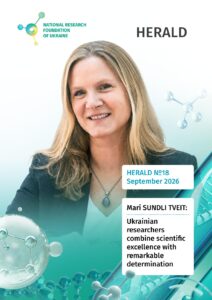
Mari Sundli Tveit has been Chief Executive of the Research Council of Norway (RCN) since 2021. She studied geography at the University of Bergen, holds a PhD in landscape architecture, and previously served as Rector of the Norwegian University of Life Sciences (NMBU). Mari Sundli Tveit is also President of Science Europe. Announcing the support for Ukrainian researchers, she said: “We need to do more for Ukraine, and there is no time to lose.”
– Solidarity is never abstract — it is truly tested when decisions have to be made quickly and under extraordinary circumstances. Could you please tell us how the decision to develop a comprehensive strategy to support science in Ukraine came about? What did you feel at that moment? Why is it important for Norway to demonstrate solidarity with Ukrainian researchers and support them?
– First of all, I want to emphasize that all Science Europe member organisations reacted with shock and profound concern to russia’s full-scale invasion of Ukraine. I was a member of the Science Europe Governing Board at the time and witnessed firsthand the strong sense of solidarity across the European research community.
Science Europe published a statement in support of Ukraine on March 1 and quickly began exploring ways to assist Ukrainian research institutions and researchers. One important step was accelerating the process that enabled the National Research Foundation of Ukraine (NRFU) to become a full member of Science Europe as early as May 2022.
From the outset, Science Europe’s ambition was not only to respond quickly, but also to contribute to strengthening Ukrainian research capacity over the longer term. Science Europe played an important role in coordinating the response of Europe’s research funding organisations and ensuring a common voice.
At the same time, it was essential that individual countries could develop their own support measures and funding schemes. Science Europe helped align these efforts, creating synergies to maximise their collective impact.
On a personal level, I felt deep concern for colleagues working under extraordinarily difficult circumstances, and immense admiration for the resilience they have shown in sustaining research, education and international cooperation throughout the war.
For Norway it was of course important to show solidarity with Ukraine and the Ukrainian research community, and we understood that we needed to adopt a comprehensive strategy to support science in Ukraine.
– In August 2025, the RCN and the NRFU launched a joint initiative “Recruit a Researcher from Ukraine for an Ongoing Researcher Project”. Thanks to this initiative, 16 Ukrainian researchers are now able to continue their work during the wartime, expand their professional networks, and integrate into the international research community. What benefits does such cooperation bring to Norwegian research teams and to Norwegian science as a whole?
– This kind of cooperation is extremely valuable for both parties. For Ukrainian researchers, it creates continuity, networks and opportunities to remain active in international science despite wartime conditions. Norwegian research teams benefit from working closely with highly motivated and very competent partners with strong disciplinary expertise and important experience from working on urgent societal challenges.
More broadly, Norwegian science benefits from stronger international collaboration, access to complementary knowledge, and partnerships that can open new research questions and perspectives.
These collaborations also strengthen our own research communities by making them more internationally oriented, more resilient and more aware of how important research is in times of crisis.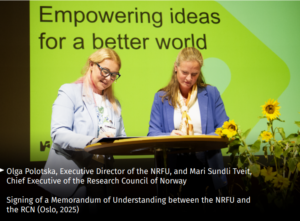
– The topics of the successful projects under the RCN-NRFU joint initiative are very diverse: from measuring the cosmic microwave background spectrum to the ideological production and practices of wartime putinism. What are your impressions of the work of these teams, and of Ukrainian researchers in particular?
– I am very impressed by both the breadth and the quality of the projects. The fact that the topics range from frontier basic science to studies of war, democracy and ideology shows the strength and diversity of Ukrainian research.
It also demonstrates that Ukrainian researchers are not only responding to the immediate consequences of war, but are continuing to contribute to the international advancement of knowledge across disciplines.
My impression is that Ukrainian researchers combine scientific excellence with remarkable determination and adaptability. Under conditions that would be overwhelming for any research system, they have managed to develop ambitious ideas and strong partnerships. That deserves both recognition and continued support.
– In February 2026, after russian missile strikes left large parts of Ukraine without heating, and electricity was available in many regions only for two to three hours a day, the RCN and the NRFU announced a joint research call for proposals on mental health in Ukraine during and after wartime. The total funding for the call is NOK 30 million. How was the decision made to focus specifically on this topic? What outcomes would you like to see from this call for proposals?
– We very much appreciated receiving suggested topics from the NRFU Scientific Council. The discussions inside RCN were easy. The decision to focus on mental health reflected both the urgency of the situation and the need for research that can make a direct difference in people’s lives.
The war has created enormous psychological strain for the Ukrainian population, and we understand that when critical infrastructure is repeatedly attacked, the pressure on individuals, families and communities becomes even greater.
We therefore saw a need for research-based, concrete and scalable interventions that are relevant in a society at war and in the period of recovery that will follow. Research and knowledge from this call can be translated into practical support measures, services and policies that improve mental health for different groups affected by the war. At the same time, I hope the call will build lasting cooperation between Norwegian and Ukrainian researchers and strengthen Ukraine’s capacity in an area that will remain critically important for many years.
– The Research Council of Norway has a long and significant history of establishment and development. Today, on behalf of the government, it invests more than 11 billion NOK annually in research and innovation. Which areas of research are currently priorities for Norway, and why?
– Norway’s research priorities reflect both long-term national needs and major global challenges. Broadly speaking, we are investing in high-quality research across disciplines, while giving particular attention to areas such as the green transition, health and welfare, technology and digitalisation, oceans, and social cohesion, security and preparedness.
These priorities are important because Norway, like other countries, needs knowledge that can help us manage climate change, strengthen competitiveness and innovation, improve public services and safeguard democratic and societal resilience.
At the same time, we must maintain strong basic research, because long-term scientific quality is the foundation for innovation and for our ability to respond to unforeseen challenges.
– Has russia’s war against Ukraine changed Norway’s approach to research funding (or research funding priorities)?
– Yes, the war has influenced the context in which we think about research priorities, especially by underlining the importance of security, preparedness, resilience and democratic institutions.
The war has reminded us that research policy cannot be separated from geopolitical realities. At the same time, I would say that the war has accelerated rather than fundamentally changed several priorities that were already becoming more important – such as societal security, emergency preparedness, trustworthy technology, and international cooperation with like-minded partners.
It has also made the value of supporting threatened research communities much more visible. So, the overall direction is still long-term and strategic, but the war has increased the sense of urgency around certain areas and made solidarity with Ukrainian research a clear priority.
– You studied geography at the University of Bergen and were Rector of the Norwegian University of Life Sciences (NMBU). NMBU’s mission is to contribute to the well-being of the planet. Its research helps people around the world address global challenges in environmental protection, sustainable development, improvements in human and animal health, renewable energy, food production, and land and resource management. From your perspective, how can science and universities maintain their mission in a time when the world is once again facing war and instability? And what can universities actually do? Not in theory, but already today.
– Science and universities have a fundamental responsibility to remain places where knowledge, critical thinking and long-term perspectives are protected – especially in times of war and instability.
Their mission does not disappear in a crisis; in many ways it becomes even more important. Universities can act today by keeping education and research going, protecting academic freedom, supporting displaced students and researchers, and building international partnerships that help sustain threatened knowledge communities.
Universities can also contribute directly by producing knowledge that societies need in order to respond to crises – whether in health, energy, food systems, security or democratic resilience.
In practical terms, this means opening networks, sharing infrastructure and expertise, creating opportunities for mobility and collaboration, and ensuring that research continues to serve both people and society under difficult conditions.
– What do you find most interesting in your work as Chief Executive of the Research Council of Norway? What ‘ultimate goal’ do you set for yourself in this role?
– What I find most interesting is the opportunity to work at the intersection between excellent research, major societal challenges and public policy.
The Research Council has a unique role because we are both a funder of research and an adviser on research policy. That means we can help create the conditions for new knowledge, while also contributing to how knowledge is used in society.
The ultimate goal, as I see it, is to help ensure that Norway has a strong, open and forward-looking research system that delivers high quality, fosters innovation and gives society the knowledge it needs to make good decisions. In that role, it is especially motivating to support research that not only advances science, but also helps people and societies navigate complex change.
– Are Norwegian researchers prepared to work in unpredictable crisis situations such as technological disasters or war? Is this being discussed within the research community? Are there established protocols for responding to emergencies?
– I believe Norwegian researchers are well prepared in many areas to contribute knowledge in crisis situations, particularly in fields linked to health, technology, climate, societal security and emergency preparedness.
But, as we have seen in recent years, being prepared requires continuous development. The research community is increasingly discussing how research can contribute to resilience in the face of war, technological threats, infrastructure disruption and other emergencies.
There are established protocols and preparedness systems at institutional and national levels, but research also has to remain flexible and able to respond quickly when new challenges arise.
One important lesson from Ukraine is that strong international collaboration is itself a form of preparedness, because it helps research communities remain active and connected even under extreme conditions.
– Do you see the Ukrainian research community working under conditions of missile attacks, blackouts, and limited funding as a genuine partner in addressing today’s global challenges? How does the RCN consider further cooperation with the Ukrainian research community?
– The Ukrainian research community has demonstrated extraordinary resilience, professionalism and dedication under circumstances that are difficult to comprehend for all of us who are not directly affected.
Both as President of Science Europe and as Chief Executive of the Research Council of Norway, I see Ukrainian researchers as valued and indispensable partners in addressing shared European and global challenges. Our cooperation must be both long-term in its ambition and responsive to urgent needs.
We want to continue strengthening our partnerships through joint calls, researcher mobility, project development support and thematic collaboration in areas where Ukraine’s experience and expertise are particularly important, including mental health, societal security, democracy and reconstruction.
Both Science Europe and Norway are committed to supporting Ukrainian research and continue to build lasting research partnerships based on mutual benefit, respect and a shared commitment to knowledge, excellence and international cooperation.
Interviewed by Svitlana GALATA