

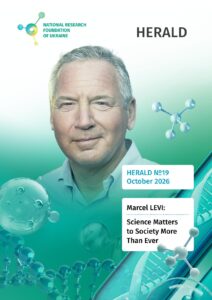
In 2023, the Dutch Research Council (NWO) and the National Research Foundation of Ukraine (NRFU) established a collaboration that opened up new opportunities for Ukrainian researchers to work with leading Dutch research teams. The partnership has provided important support for Ukrainian science amid the full-scale war, while also helping to forge new research links between Ukraine and the Netherlands.
What is driving NWO to expand its support for Ukrainian researchers?
What results are the joint teams achieving, and how can we build a resilient research system in such challenging times?
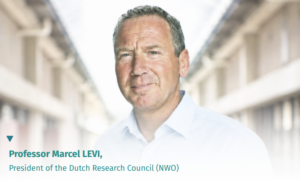 We asked Professor Marcel LEVI, President of the Dutch Research Council (NWO), to reflect on these and other questions.
– Professor Levi, your first term as President of NWO coincided with the COVID-19 pandemic, russia’s full-scale war against Ukraine, and growing pressure on academic freedom worldwide. In April this year, you were reappointed for a second five-year term. Looking back, what has been the greatest challenge for you over the past five years?
– I think each of these important events that you mention presented a significant challenge. On top of that, we’ve been on quite a rollercoaster ride: first, we had a very research-supportive government, then a two-year period of severe austerity in research funding, and now a new government that is trying to reverse many of the dismal decisions made by its predecessor.
– Before joining NWO you led one of London’s largest NHS hospital trusts. At the same time, you remain a practising physician and continue to work shifts in the emergency department. How does your clinical work influence your role as President of NWO? And conversely, has your experience leading NWO changed the way you think about medicine?
– I think all these roles are rather synergistic. I love being on the workfloor and doing ‘real’ things.
And that experience helps me in decision-taking for larger groups of researchers or for the research system. The science work at NWO is a great inspirator for my clinical work.
– Recent years have demonstrated how fragile the environment in which science operates can be: a global pandemic, war, and increasing pressure on academic freedom. Have these events changed your own understanding of why society needs science?
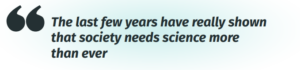
– In my view science is at the center of society and progress. That means that in an inflammable world, science is always at risk. Despite that, as you say, I really think the last few years have really shown that society needs science more than ever.
– In 2023, NWO signed a Memorandum of Understanding with the NRFU. What was the decisive factor in choosing to establish this cooperation with Ukraine through the NRFU?
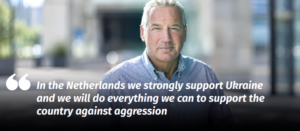
– In one word: solidarity. In the Netherlands we strongly support Ukraine and we will do everything we can to support the country against aggression.
– The joint NWO–NRFU initiative ‘Hop-On Call for Researchers Based in Ukraine’ enables Ukrainian researchers to join Dutch research projects that are already underway. Why did NWO choose this particular support mechanism? In your opinion, what makes the hop-on format especially effective for supporting Ukrainian researchers?
– I think we came to this support form in dialogue with our Ukrainian colleagues. We are actually very proud of it. And integrating Ukrainian researchers into Dutch teams with as few hassle as possible and minimizing bureaucracy was another important factor.
– Following the first call for proposals in 2023, 13 projects received funding amounting to approximately EUR 250,000. The second one, launched in 2025, supported 20 projects with a total budget of EUR 480,000. What factors led to this almost twofold increase in the programme’s funding?
– Sometimes new schemes need a bit of time before everyone is notified and prepared. We are very happy with the increased interest in the second round.
International cooperation with Ukraine is often viewed as an act of solidarity. That is indeed the case, but at the same time it is also simply extremely good science that is taking place. We would value seeing this developing in long time partnerships in the future.
– Does NWO envisage further developing its cooperation with the NRFU? If so, which forms of collaboration do you believe hold the greatest potential?
– We have just started that discussion and it is a bit too early to tell. But I think we should listen carefully to our Ukrainian partners to hear what would be best for them as well.
– The NRFU is a relatively young institution that has effectively been operating for only a few years, most of that time amid a full-scale war. Based on NWO’s own experience of institutional development, what advice would you offer to the Ukrainian foundation?
– Hard to say, but perhaps the best advice is to try to be a learning and flexible organisation. See what works and expand that activities, and if something does not work well, change it or shift to something else.
– In recent years, NWO has actively promoted the concept of a Healthy Research Culture. In the context of the ongoing transformation of modern science, which outdated practices or structural imbalances do you believe the research community should leave behind? In your personal view, what is the most important sign of a healthy research culture?
– I will give one example: I am extremely supportive of Open Science, simply said that all research results should be in the open and available to everyone in the world. The commercial position of many publishers makes this difficult and I believe we should leave that behind us.
– During periods of economic or security crises, government priorities often shift towards research with immediate practical impact. In your view, is there a risk that fundamental research – whose outcomes may only become evident decades later – could be pushed into the background?
– Yes, the greatest scientific breakthroughs will also come from fundamental science, but it simply takes a bit more time and there is obviously no guarantee. But we need to keep the pipeline of new knowledge filled to the edge.
– Before 2022, few European research systems had faced the challenge of maintaining resilience during a full-scale war. Has the war in Ukraine changed your view of what makes a research system resilient in times of crisis?
– Absolutely, we have to be much better prepared for awkward happenings in a very volatile world.
– In April this year, you officially entered your second five-year term as President of NWO. Given the current financial and political challenges facing European science, what do you see as your main priority for the next five years?
– Many, many things (smiles – Ed.). High on the agenda are impactful science, research to support strategic autonomy in Europe, the importance of regional networks, strengthening the national research system, optimization of talent support, and so forth and so on. 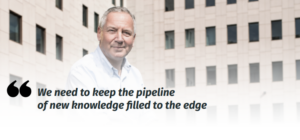
Interviewed by Svitlana GALATA