The Open4UA project has successfully reached key Milestone No. 4, confirming the readiness of national tools for implementing Open Science priorities. In particular, the project has developed important recommendations to support the further advancement of Open Science at the national level.
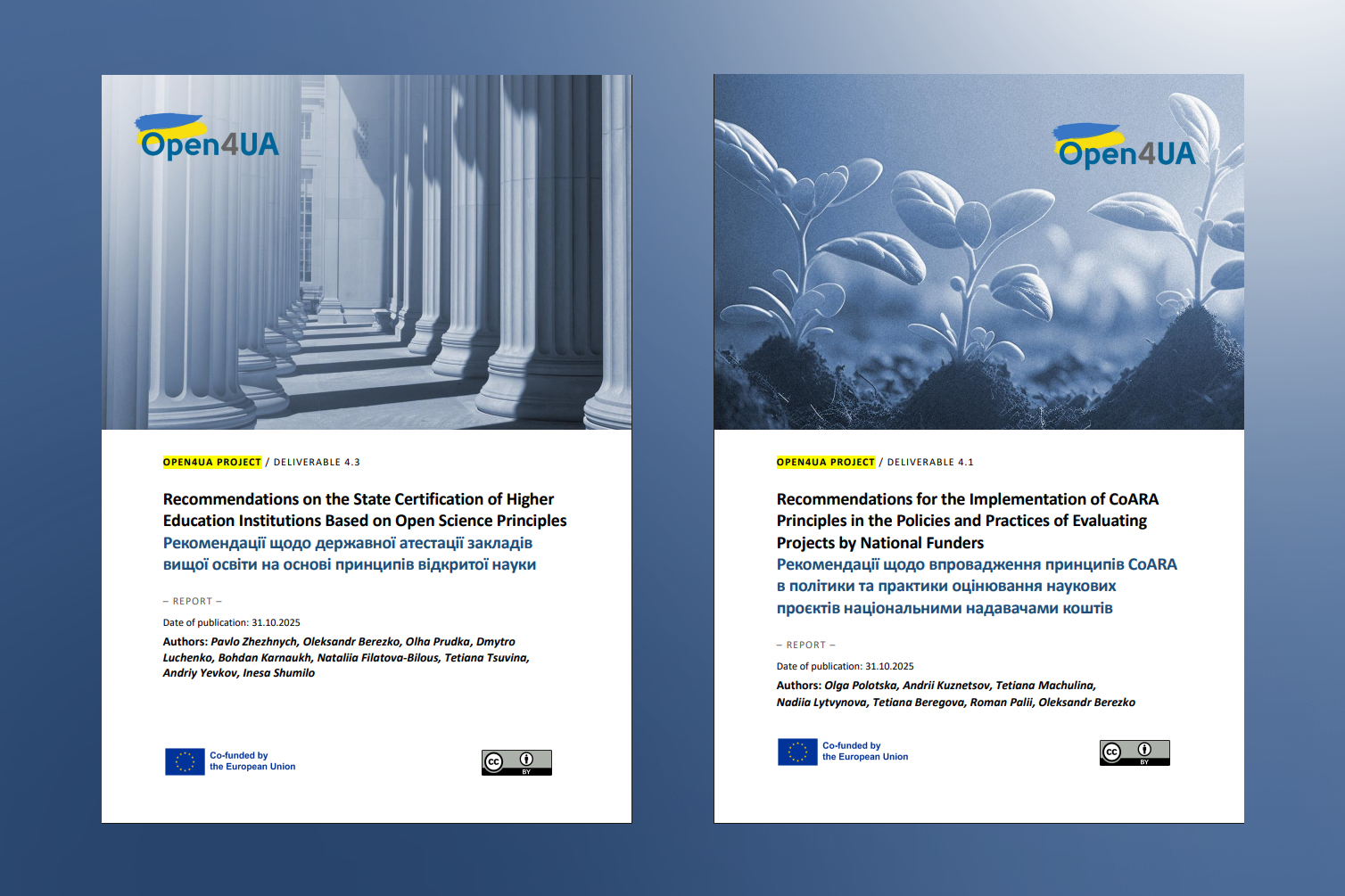
The Open4UA Deliverable D4.1 report provides strategic recommendations for integrating the principles of CoARA (Coalition for Advancing Research Assessment) into the research funding policies and practices of Ukraine’s national funding bodies. The document highlights the urgent need to reform traditional research assessment systems centred on quantitative indicators, which often fail to fully reflect the quality and societal impact of research. The report emphasises the importance of moving towards qualitative, fair and transparent assessment models based on peer review and the responsible use of metrics to support Open Science, diversity and inclusiveness.
Ukraine’s participation in CoARA is considered in the context of post-war recovery and integration into the European and global research areas. The document identifies the growing participation of Ukrainian institutions, reaching 16 by 2025, and the establishment of the CoARA National Chapter in Ukraine as important achievements. It also identifies systemic barriers, including insufficient funding, limited English language proficiency, information isolation and the effects of the war. To address these barriers, the recommendations propose legislative harmonisation, a cultural shift towards academic integrity and openness, and organisational strengthening through capacity building, greater transparency and broader international cooperation.
Ultimately, implementing CoARA principles will improve the quality and competitiveness of Ukrainian research and strengthen trust in it. This will help establish a fairer, scientifically sound assessment system aligned with European standards and reinforce Ukraine’s position as an emerging major participant in the global research community.
Despite the challenges, Ukraine’s research system continues to develop in line with global trends calling for greater transparency, openness and social responsibility in higher education and research. The National Open Science Plan, approved by the Cabinet of Ministers of Ukraine, provides the key strategic framework guiding these changes.
Central to this process is Task 5, concerning the improvement of research assessment and quality assurance, and particularly Task 5.1, which envisages updating the criteria for the state accreditation of higher education institutions and research institutions. This includes developing recommendations based on DORA and OSCAM to overcome outdated assessment systems that hinder the implementation of Open Science and institutional development in the post-war period.
Open4UA has played a key role in advancing this national research assessment reform, launched in November 2024 in accordance with Open Science (OS) and CoARA principles. Members of the Open4UA team played a leading role in the ministerial working group established under Order No. 1402 of the Ministry of Education and Science of Ukraine of 16 November 2023 to develop a new methodology for assessing research institutions. Developed in October–November 2024, this methodology draws extensively on knowledge exchange within the Open4UA initiative.
In 2025–2026, more than 370 research institutions and 130 higher education institutions will undergo state certification under the new assessment framework. Based on the results, the government plans to strengthen institutional capacity, funding mechanisms and support for leading research organisations.
Drawing on the United Kingdom’s Research Excellence Framework (REF), the new methodology introduces expert assessment of institutional impact for the first time, including contributions to scientific advancement, national defence and socio-economic progress. By combining quantitative indicators with qualitative expert assessment, the framework incorporates Open Science principles while remaining practical within the existing legal framework. This represents a significant step towards a transparent, credible and inclusive assessment system.
The report examines the key elements of the reform and outlines directions for its further development to ensure that Ukraine’s research assessment system remains dynamic, fair and aligned with Open Science principles.
D4.2. Open Database of Projects Funded by the National Research Foundation of Ukraine
The project team has also developed and launched a test version of an open online database containing information on research projects funded by the National Research Foundation of Ukraine (NRFU). The database is temporarily hosted on a test platform at https://coara.org.ua/.
The creation of the Open Database of Projects Funded by the NRFU marks an important milestone in advancing Open Science principles and transparent research management in Ukraine. The database serves as an institutional mechanism for collecting, structuring and disseminating information on research and development (R&D) projects funded from the state budget. It provides researchers, policymakers and the wider public with open access to information on research activities, funding and results.
Aligned with the European Open Science Agenda, the NRFU database contributes to the development of a national research information infrastructure that supports collaboration, accountability and evidence-based decision-making. It enables interoperability with European systems and lays the foundations for data-driven research policy and assessment.
In its concept and functionality, the NRFU Open Database is Ukraine’s counterpart to the European CORDIS database (Community Research and Development Information Service), which provides open access to information on projects funded under EU framework programmes. Like CORDIS, the NRFU database increases the visibility of funded projects, facilitates the dissemination of research results and supports stakeholder engagement. At the same time, it is tailored to the Ukrainian research context, offering detailed scientific and financial indicators at project level while complying with national legislation and digital governance standards.
Overall, the NRFU Open Database represents an important step towards Ukraine’s integration into the European Research Area (ERA). It contributes to the development of open, transparent and interoperable research data systems that strengthen trust, innovation and collaboration within the national and international research community.