Every researcher is well aware that fundamental research matters. Such research expands our knowledge of the world and lays the groundwork for future technological breakthroughs. The project “Controlled transport of topological excitations in atomic circuits for quantum sensors and quantum information processing systems” implemented by researchers from Taras Shevchenko National University of Kyiv and funded by the National Research Foundation of Ukraine (NRFU) is important both for the advancement of research and for many sectors of the economy. Its results will be useful for the development of new navigation systems, mineral exploration technologies, etc.
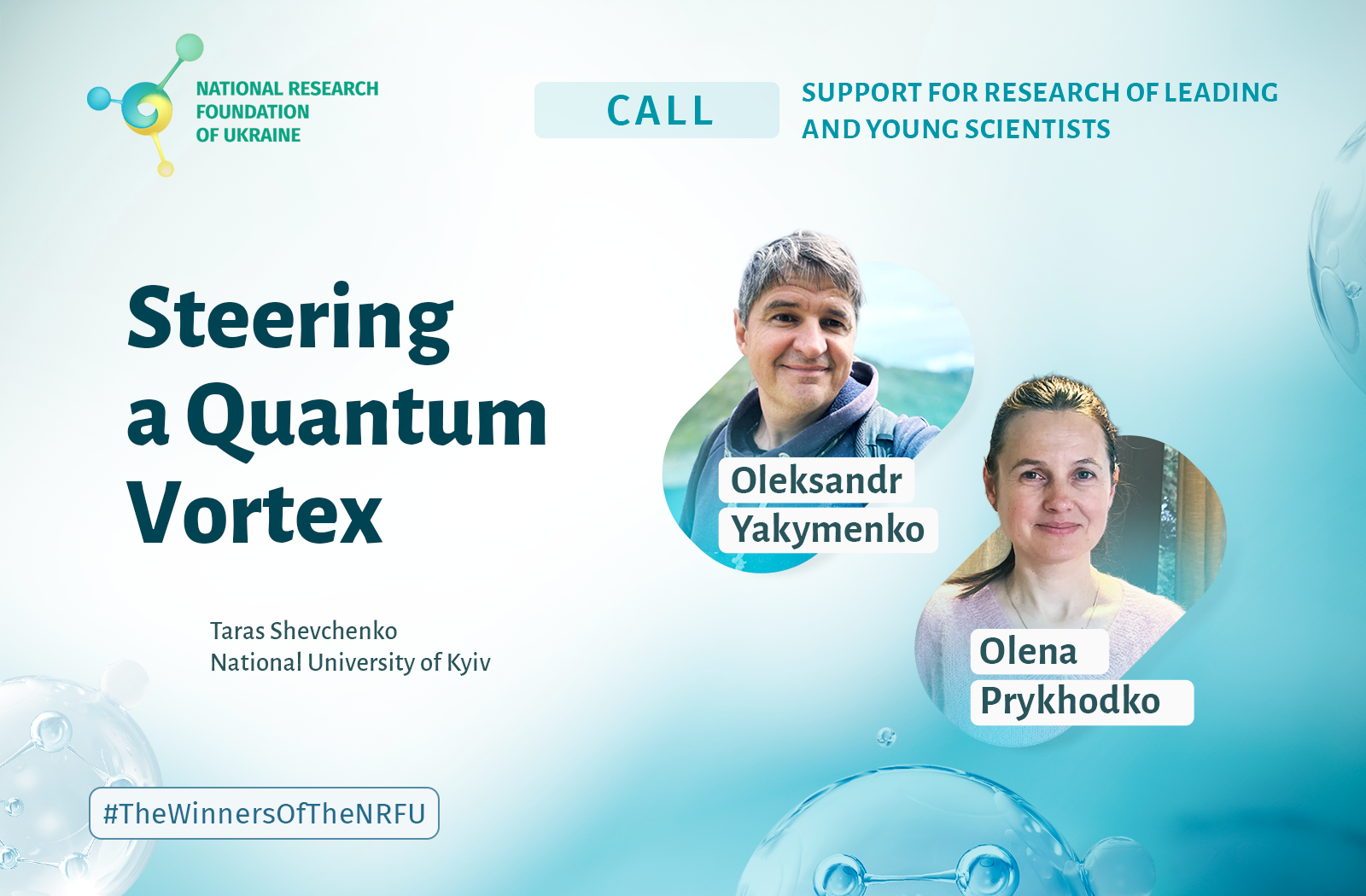
The project’s findings are presented by researchers from the Department of Quantum Field Theory and Cosmomicrophysics at Taras Shevchenko National University of Kyiv: Oleksandr Yakymenko, Associate Professor (PI at the first stage), and Olena Prykhodko, Associate Professor (PI at the final stage).
“We applied with this idea for the call for proposals because it lies at the intersection of fundamental physics (the science of superfluidity and macroscopic quantum phenomena) and its practical applications”, explains Oleksandr Yakymenko. “We are primarily interested in how topological excitations (quantum vortices) arise and evolve in quantum systems, and whether these vortices can be steered. At the same time, being able to control topological excitations in quantum systems opens the door to practical solutions. This is the foundation for creating quantum-based gyroscopes – devices that track any changes in an object’s position and orientation in space, and next-generation sensors. They will be thousands of times more sensitive than current counterparts. This is critical for navigation systems in environments where GPS does not work, for mineral exploration, or monitoring gravitational changes. That is why such research is important for Ukraine and the world”.
What is the core idea of the project? What has been achieved?
“Imagine that you try to transmit a message written on the surface of water in a swimming pool. If you simply disturb the water, the waves will quickly fade and disperse – the information will be lost. But if you manage to create a small, stable whirl (vortex), it can travel through the pool for a long time while preserving its shape”, describes Olena Prykhodko. “In our microworld, such ‘whirls’ are called quantum vortices. We work with extremely cold atoms (almost at absolute zero), where friction disappears. As a result, the motion of atoms in such a vortex does not consume energy and does not decay over time. The core idea of our project is to learn how to ‘tame’ these quantum vortices: to create them, move them along specially designed atomic channels (routes), and read out the information they carry. We are developing a ‘transport system’ for the quantum world, where a vortex is a reliable package that will not fall apart from the slightest push or noise”.
While implementing the project, the researchers obtained results of world-class significance, confirmed by publications in prestigious journals, namely Physical Review and New Journal of Physics. In particular, theoretical models of steered vortex transport in complex atomic chains were developed. The researchers demonstrated that vortices can be manipulated using laser light and that conditions for their stable motion can be created.
“We have identified the conditions under which a vortex can oscillate stably between two ring-shaped superfluid traps. A model of a quantum trigger was created, essentially a prototype of an elementary quantum memory cell”, continues Olena Prykhodko.
The researchers also developed promising physical platforms for creating new types of sensors. “This opens the way to the creation of quantum-based gyroscopes which will be many times more accurate than what exist today”, adds the researcher.
The project has been successfully completed, but its implementation was far from easy.
“The war became a serious challenge for the project implementors. At the beginning of the full-scale invasion of Ukraine by russian troops, funding was suspended. After work resumed, it was extremely difficult to do lengthy calculations during power outages”, recalls Olena Prykhodko. “There were also difficulties with traveling abroad which complicated cooperation with international colleagues. Despite all this, we managed to complete the project, obtained significant results, and outlined prospects for further research”.
Olena Prykhodko advises researchers who are planning to apply for NRFU calls for proposals not to shy away from ambitious ideas, even if they may seem far-fetched at first. “Grant committees value research courage”, she says with a smile.
Another key to success is a strong team. “Involve young researchers. The energy of students and PhD candidates combined with the experience of leading researchers is the perfect mix for success”, noted Olena Prykhodko. “It is also important to plan realistically and report thoroughly. And, of course, you need to be the best in your field”.
This ideal mix of success can indeed be seen in the team that implemented the project. Alongside experienced researchers, early career researchers worked boldly, taking responsibility and achieving excellent results. For many of them, the project became the starting point of their research careers and gave them an opportunity to make a name for themselves in the world of science.
“We structured our work so that strong theoretical ideas were supported by thorough checks and collaborative discussion at every stage”, Olena Prykhodko told. “We went through a challenging path that included technical dead ends, and recalculations, and the search for better approaches. But thanks to mutual support, discipline and trust, we achieved results we can be proud of. Our team consists of people who do not just do their job, but live and breathe science. It is them who made the project a success”.
Interviewed by Svitlana GALATA