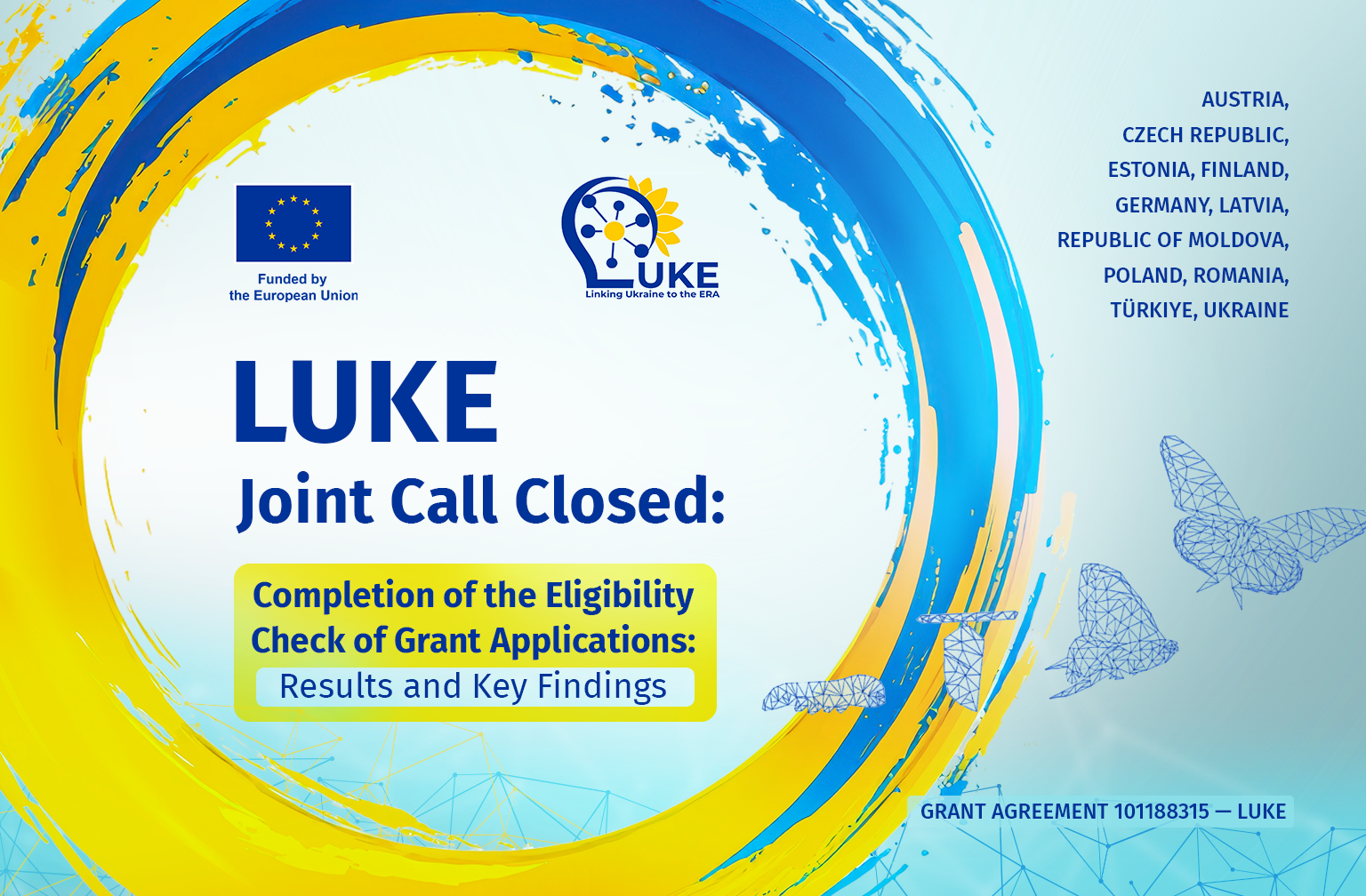
Following the LUKE Joint Call pre-announcement, we invite researchers in Ukraine to join a practical webinar on partner search, consortium building and science diplomacy in practice.
Date (please select): 29 December 2025 or 30 December 2025
Time: 10:45 – 12:00 (EET), 09:45 – 11:00 (CET)
Format: Online. Zoom link will be sent to the registered participants
Registration: https://cutt.ly/gtsVnCDj
Language: English
Why join? This webinar turns the call set-up into practical next steps: how to identify suitable partners, shape a consortium and approach collaboration in a way that builds trust, reciprocity and long-term cooperation.
The Joint Call is planned to be published on 30 January 2026 with a proposal submission deadline of 30 April 2026. This is an ideal moment to start partner search and develop your project ideas. During the event, you will receive an overview of the LUKE Joint Call essentials for consortium building and practical guidance on how to approach potential partners.
With the end of year period approaching, it is also an opportunity to congratulate potential partners on the season and inform them about the LUKE Joint Call and the collaboration opportunity it offers.
Practical partner search tools will be introduced that you can use immediately, including how to develop clear collaboration requests and offers. In addition, the Austrian Research Promotion Agency, FFG, will present its stakeholders and opportunities to identify suitable partners.
You will get practical advice from the diplomatic community on supporting researchers and companies to find partners, including how diplomatic networks help open doors and why effective science communication matters.
Moreover, you will have the opportunity to contribute to the development of a Q&A list on LUKE Joint Call consortium building.
Who can participate? The webinar is open to researchers who are currently working in Ukraine at a university or/and research performing organisation. Institutional affiliation is important, as the LUKE Joint Call is open to organisations.
Please register by 25th December 2025, at the following link: https://cutt.ly/gtsVnCDj
- Agenda is available here: AGENDA (pdf)
Funded by the European Union. Views and opinions expressed are however those of the author(s) only and do not necessarily reflect those of the European Union or European Research Executive Agency (REA). Neither the European Union nor the granting authority can be held responsible for them.