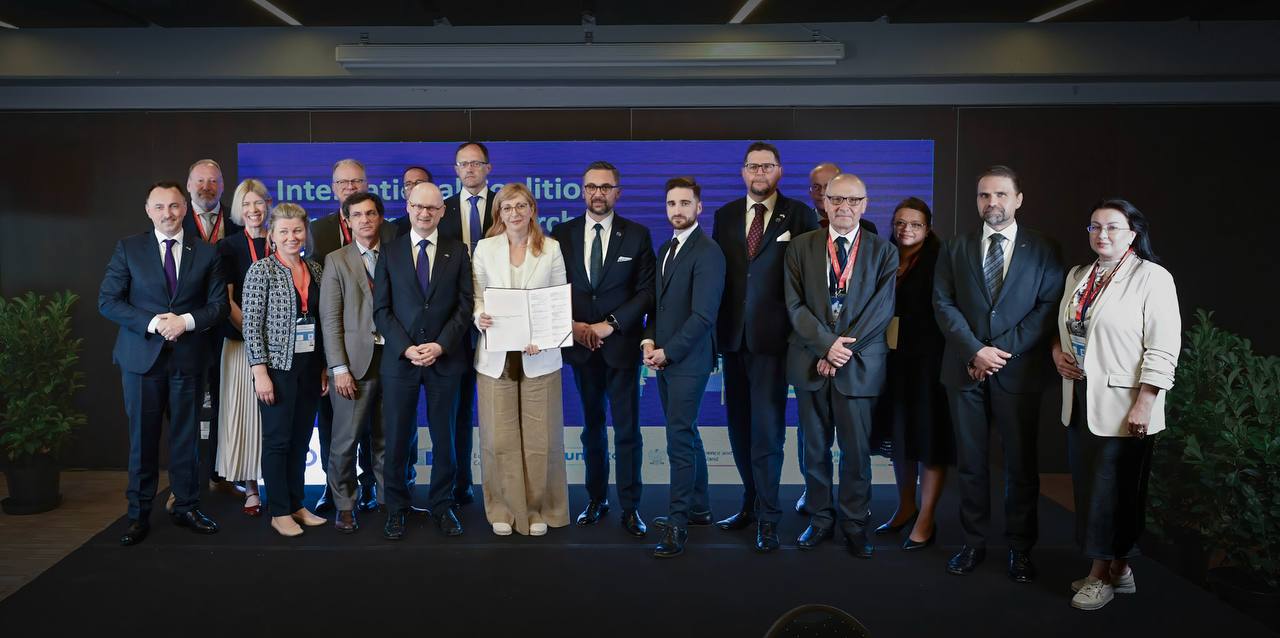
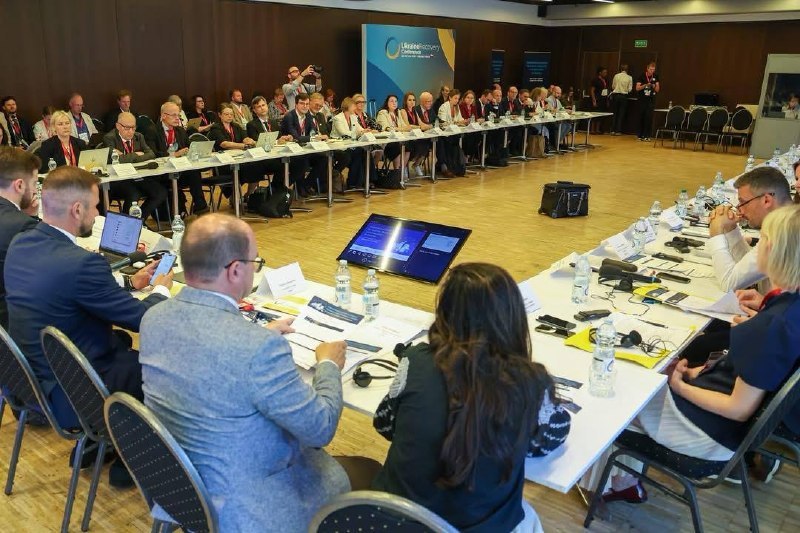
One of the key outcomes of the first meeting of the High-Level Steering Committee of the International Coalition for Science, Research and Innovation in Ukraine, held within the framework of the Ukraine Recovery Conference (URC2026), was the signing of the Gdańsk Declaration on Science, Research and Innovation in Ukraine.
The Document was prepared by the Secretariat of the International Coalition in cooperation with the governments of its member states. Representatives of the National Research Foundation of Ukraine (NRFU), as part of the official delegation, contributed to the discussions and development of the document’s provisions during the drafting process.
The Gdańsk Declaration reaffirms the commitment and readiness of Coalition members to continue their active participation in joint international efforts aimed at strengthening and developing Ukraine’s research and innovation system during the war and in the post-war period, as well as supporting Ukraine’s integration into the European Research Area.
The Declaration establishes shared priorities, reinforces coordination mechanisms, and creates opportunities for launching new programmes, partnerships, and collaborative projects in the fields of research and innovation.
This policy document is a logical continuation of the initiative launched during URC2025 in Rome when the International Coalition was established. It currently brings together 46 governments and organisations from 21 countries, as well as 9 international organisations, including the European Commission, UNDP, and UNESCO. In this sense, it represents a further step – a transition from political support to practical coordination of joint efforts.
The Declaration also highlights the challenges faced by Ukraine’s science sector as a result of russian aggression and emphasises the need to continue international cooperation by strengthening coordination mechanisms among partners and establishing a basis for launching new programmes, partnerships, and joint projects in research and innovation. These joint efforts will contribute to preserving human capital, restoring research infrastructure, and strengthening the capacity of Ukraine’s research and innovation system to respond to current societal challenges and needs.
The Declaration defines three main areas of cooperation:
Preserving Ukraine’s scientific potential today. This involves supporting Ukrainian researchers, research teams, and early-career researchers, as well as ensuring access to modern equipment, research infrastructure, international research networks, and partnerships. Particular attention is given to preserving scientific schools and engaging the potential of Ukrainian researchers currently working abroad.
Reconstruction and modernisation of Ukraine’s research and innovation system. This includes rebuilding research infrastructure, developing a modern research funding system, strengthening institutional capacity, improving the management of grant programmes, advancing technology transfer, commercialisation of research results, and introducing modern approaches to research governance.
Science and innovation as a driver of Ukraine’s recovery. The Declaration emphasises that research should directly contribute to economic recovery, the development of new technologies, evidence-based policymaking, enhanced national competitiveness, and the acceleration of Ukraine’s integration into the European Research Area.
The document also provides for expanding Ukrainian researchers’ access to international research infrastructures, state-of-the-art equipment, joint grant schemes, international research networks, and organisations.
In addition, the partners agreed on regular consultations and coordination of future joint initiatives, establishing a basis for systemic rather than ad hoc support for Ukrainian science.
A long-term and ambitious goal is also set out – to gradually bring Ukraine’s research funding level closer to 3% of GDP after the end of the war, in line with the European Research Area benchmarks.
It is important that international partners have officially confirmed that the development of research and innovation is one of the priorities of Ukraine’s recovery. This further demonstrates that support for Ukrainian science is seen not as a temporary response to the challenges of war or a separate strand of humanitarian assistance but as an integral part of long-term international policy for reconstruction, modernisation, and European integration of Ukraine, as well as one of the foundations of economic development, technological competitiveness, and sustainable recovery of the state.