What do early cancer diagnostics, food quality control, and river purity monitoring have in common? All of these processes can be carried out using enzymes – natural biocatalysts capable of recognising substances at the molecular level. Enzymatic analytical methods form the basis of today’s most advanced biosensor systems.
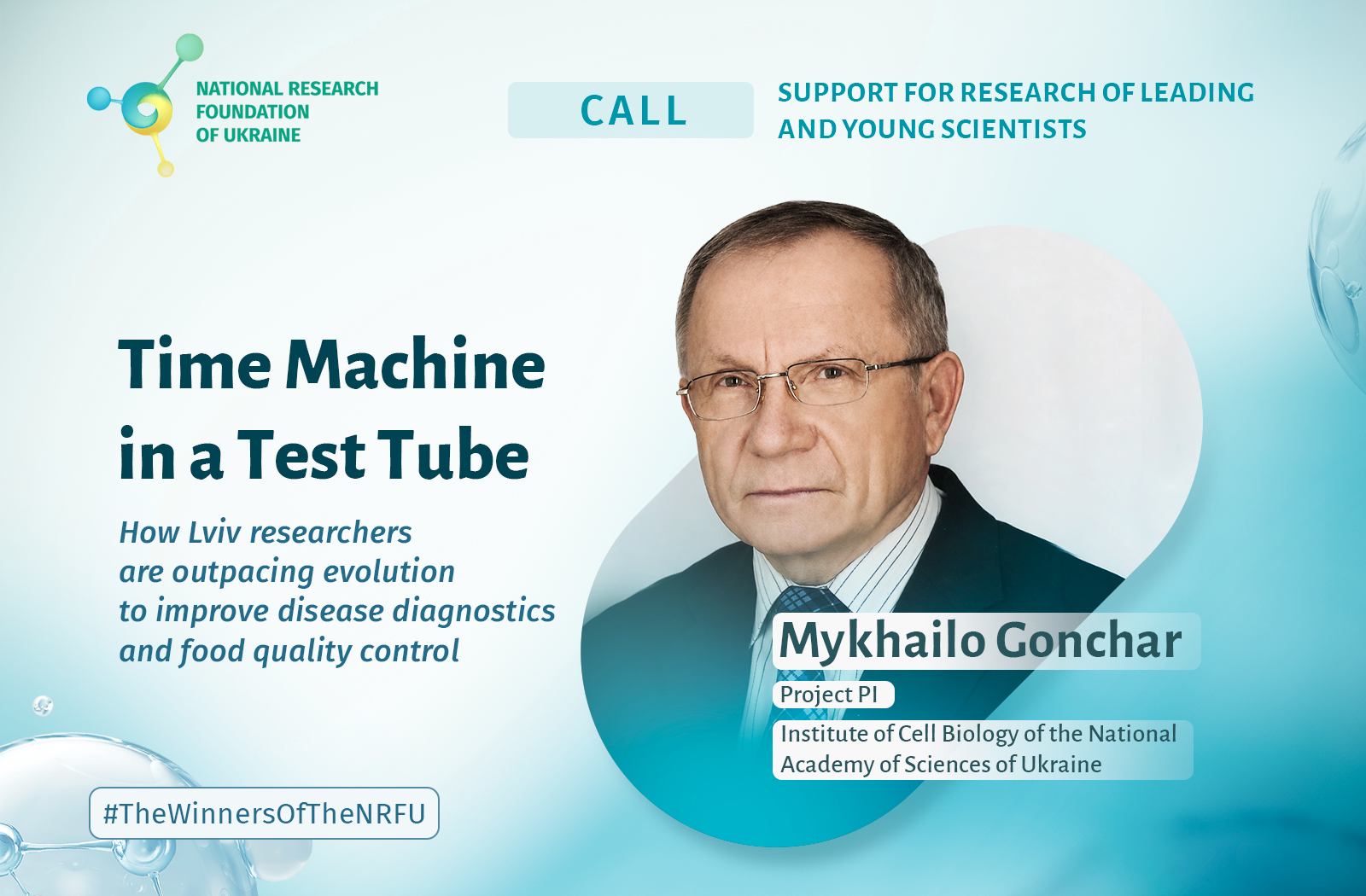
However, enzymes are evolutionarily adapted to function only within living cells and rapidly lose their properties outside them. A team of researchers from the Institute of Cell Biology of the National Academy of Sciences of Ukraine (NAS of Ukraine), led by Mykhailo Gonchar, Head of the Department of Analytical Biotechnology and Corresponding Member of the NAS of Ukraine, has found a way to outsmart nature by creating stable artificial enzyme analogues.
Thanks to grant funding from the National Research Foundation of Ukraine (NRFU), the researchers successfully implemented the project “Development of new nanozymes as catalytic elements for enzymatic kits and chemo/biosensors”.
Evolution in 24 Hours
What is the essence of the development? In simple terms, the researchers have learned to create artificial analogues of natural enzymes – nanozymes.
“In essence, nanozymes are analogues of primordial catalysts from which life on Earth once began”, explains Mykhailo Gonchar. “Nature spent billions of years of evolution transforming them into modern complex enzymes. In the laboratory, we launch a kind of accelerated time machine: we synthesise nanozymes in a test tube in just one day. They have a much simpler inorganic structure, yet they function even under extreme conditions and are extremely stable”.
However, synthesising the material is only half the challenge. Since the starting materials are selected empirically, the researchers carried out a substantial amount of routine work: testing hundreds of obtained nanomaterials to identify those that perfectly replicate the function of a ‘living’ enzyme.
From Yoghurt to Cancer Markers: Practical Value of the Research
The Lviv-based biotechnologists focused on developing a synthetic ‘nanoperoxidase’ (in nature, an enzyme derived from horseradish root). By synthesising a range of metal-based nanozymes and combining them with natural microbial enzymes, the researchers constructed unique laboratory prototypes of devices – amperometric bio-nanosensors. These new devices and analytical methods are intended for practical use across multiple fields.
First, the researchers thoroughly studied a laboratory prototype of the most effective biosensor for glucose analysis. This device demonstrates high sensitivity and can efficiently operate both with human biological fluids in clinical diagnostics and with fruit juices in industrial production.
Following the official completion of the project, the research group filed a patent application for a new enzymatic–photometric method for analysing the final metabolite of the hormone serotonin (5-hydroxyindoleacetic acid). This is a highly important step for medicine: elevated levels of this substance in the body serve as a clear biomarker of neuroendocrine malignant tumours, while reduced levels may indicate post-traumatic stress disorder (PTSD).
In parallel, the developed sensors open up new opportunities for rapid analysis of lactate (lactic acid) and ethanol in the food industry. The innovations have already been successfully tested on real samples of commercial yoghurts, wine materials, and wines. For example, the device for alcohol detection delivers a clear result in just 10 seconds and has a record-low detection limit among all known global counterparts. In other words, it is one of the most sensitive devices in its class worldwide.
Another patent application from the Lviv researchers concerns a nanozyme-based photometric method for determining hydrogen peroxide content in antiseptics. This makes it possible to control the quality and safety of disinfectants in both household and industrial settings more simply and efficiently.
A Test of War
The implementation of the project coincided with one of the most challenging periods in Ukraine’s history. The full-scale invasion of Ukraine by russian forces in 2022 put the research at risk: funding from the NRFU was suspended, and some research group members temporarily relocated abroad.
Nevertheless, the work did not stop. After funding was restored, the researchers completed the projct and continue to actively advance in the field of nanozymes.
What is needed for these technologies to reach the Ukrainian market? Mykhailo Gonchar takes a realistic view:
“The main obstacle today is the war and the generally weak innovation climate in the country. For developments lie these to reach production, Ukraine needs a well-developed infrastructure of small companies. With investment or grant support, such companies could launch small-scale pilot production of innovative products to test the market demand and subsequently scale up manufacturing”.
Science is a Journey of Persistence
Behind every scientific achievement stand dedicated people. Mykhailo Gonchar is convinced that his research group is, without exaggeration, outstanding – each member is always ready to support and assist their colleagues. The project brought together a multidisciplinary group of biologists, chemists, and physicists.
For example, Andriy Zakalskiy, PhD in Biological Sciences, cloned genes and engineered high-yield enzyme-producing strains; Oksana Zakalska, Lead Engineer, optimised microbial growth conditions; and Galina Gayda, PhD in Chemistry, was responsible for enzyme isolation, purification, and characterisation. The synthesis and characterisation of nanozymes, as well as the direct construction of biosensors, were carried out by Nataliya Stasyuk, Doctor of Biological Sciences; Olha Demkiv, PhD, Researcher; and Tetiana Prokopiv, PhD, Researcher; and Roman Serkiz, Engineer.
Important technical assistance was provided by Engineer Mariya Gorecha, while student Olga Smyk, combined her studies at Ivan Franko National University of Lviv with gaining hands-on experience in bio- and nanotechnology experiments.
“To colleagues who are considering applying for NRFU calls for proposals, I would advise them not to be afraid”, concludes Mykhailo Gonchar. “The key is to have a strong idea that addresses contemporary challenges and has the potential for practical application, as well as a strong research group. Success depends on attention to every detail in the application. Even if the first attempt is unsuccessful, science is a journey of persistence. Do not stop, keep improving, and believe in your team and your project”.
Interviewer: Svitlana GALATA