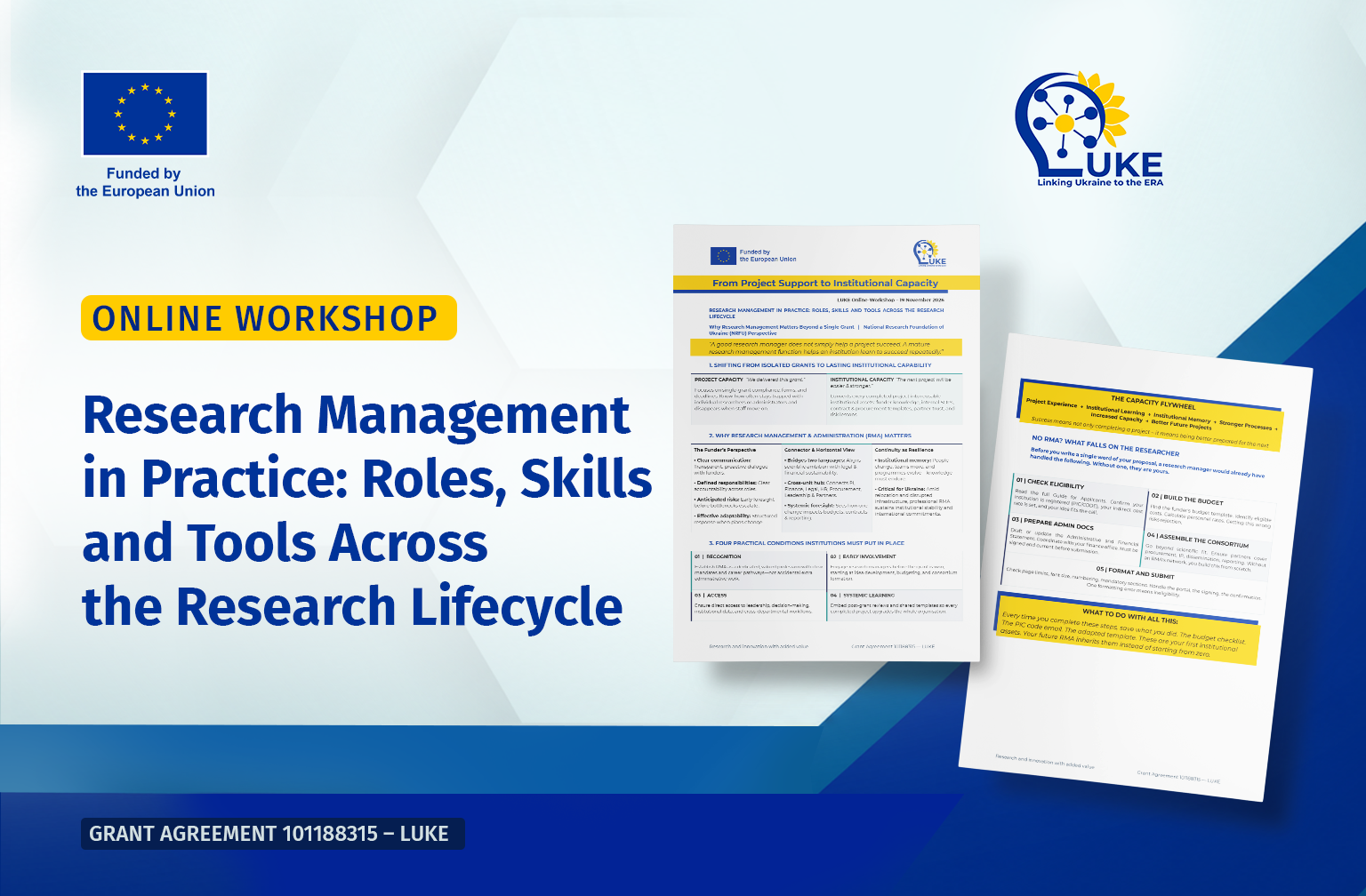
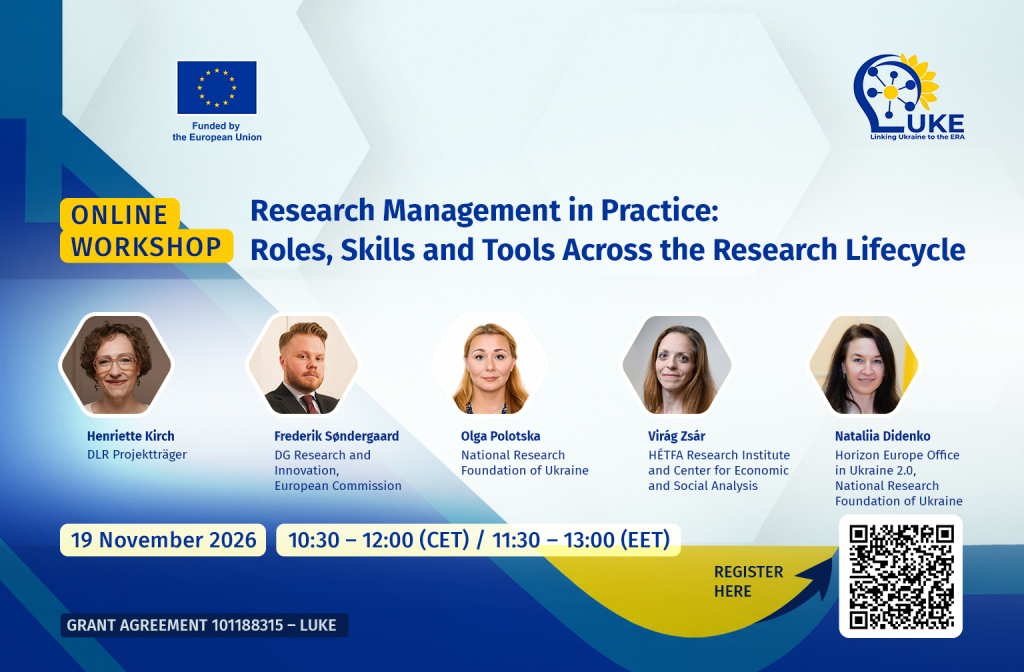
On 19 November 2026, the LUKE project hosted an online workshop dedicated to the practical aspects of research management. The event was organised by the German Project Management Agency (DLR-PT) and the National Research Foundation of Ukraine (NRFU).
The workshop provided a valuable platform for representatives of Ukrainian and European institutions to exchange knowledge, share experiences and discuss practical approaches to strengthening research management. Particular attention was paid to the roles and responsibilities of research managers, the professional competencies required in this evolving field, and the tools and practices that support effective management at every stage of the research lifecycle.
The event attracted considerable interest from the research community, with 67 joining the online workshop. It brought together a diverse international audience, with participants representing institutions from Ukraine, Germany, Belgium, Azerbaijan, Iraq, Poland, Italy, Greece, Spain etc. This broad geographical representation highlighted the growing international interest in research management and the importance of cross-border cooperation in developing institutional capacities and professional expertise.
The event was moderated by Henriette Kirch, representing the DLR-PT.
Opening remarks were delivered by Frederik Søndergaard, a representative of the European Commission’s Directorate-General for Research and Innovation. In his welcoming remarks, he emphasized the importance of Research Management Administration in order to make use of the grants that are available within the Horizon Europe Funding Programme.
Virág Zsár, an expert at the HÉTFA Research Institute and Center for Economic and Social Analysis, presented the European context of research management development. Her presentation explored that research management more and more becomes a profession. Within ERA Action Plan 17, they push research management forward: focusing on four areas: recognition of the research management profession, upskilling, networking and capacity building. Particular attention was given to the European Competence Framework for Research Managers (RM Comp), learning opportunities and the integration of research management into institutional HR policies and strategies. She gave a lot of insides, where to find further information. One is the EARMA Academy.
Nataliia Didenko, representing the Horizon Europe Office in Ukraine 2.0 of the National Research Foundation of Ukraine, outlined the role of research managers across the entire research lifecycle – from identifying funding opportunities and developing competitive proposals to project implementation, reporting, dissemination and exploitation of results.
Nataliia explained that research management does not start, when a grant is awarded, it starts much earlier. Using a modelled Horizon Europe project as an example, she demonstrated how professional support helps coordinate partners’ activities, plan resources, comply with funding requirements and manage risks. Participants were also introduced to professional development tools and initiatives, including RM Comp, CARDEA, RM ROADMAP and other opportunities.
From Project Support to Institutional Capacity
Olga Polotska, Executive Director of the National Research Foundation of Ukraine, delivered a presentation entitled “From Project Support to Institutional Capacity: Why Research Management Matters Beyond a Single Grant”.
From a research funder’s perspective, she emphasised the importance of clear communication, defined responsibilities, anticipation of risks and effective responses to change. The speaker highlighted the role of research managers in connecting researchers, administrative departments, institutional leadership, funders and partners.
Particular emphasis was placed on ensuring that each completed grant leaves the institution with improved procedures, professional knowledge, partner relationships and experience in risk management. Preserving this institutional memory is particularly important for the resilience of Ukrainian institutions in wartime.
Among the necessary steps, Olga Polotska identified recognition of research management as a profession, early involvement of research managers, their access to information and decision-making processes, and systematic learning from completed projects.
The workshop combined an overview of European approaches with practical tools for supporting research teams and a funder’s perspective on management quality. Cross-cutting themes included the professionalisation of research management, cooperation between institutional departments, risk management, preservation of institutional memory and the transformation of project experience into a foundation for long-term development.
The event materials are available at the following links:
- Presentation from the LUKE Workshop “Research Management in Practice – Roles, Skills and Tools Across the Research Lifecycle” 19 November 2026 (PDF)
- One-pager ‘From Project Support to Institutional Capacity’ (PDF)
This workshop is part of the LUKE project, funded by the European Union (Grant Agreement 101188315).