Today, as Ukraine continues to face the challenges of war, Ukrainian healthcare professionals are confronted daily with a large number of severe blast, gunshot and burn injuries. Rapid and effective treatment of such wounds is essential for saving lives and reducing the risk of long-term disability. While conventional wound dressings protect the affected area, they leave it effectively invisible to clinicians. Assessing the healing process requires frequent removal of the dressing, causing additional pain for patients, damaging newly formed tissue and increasing the risk of infection.
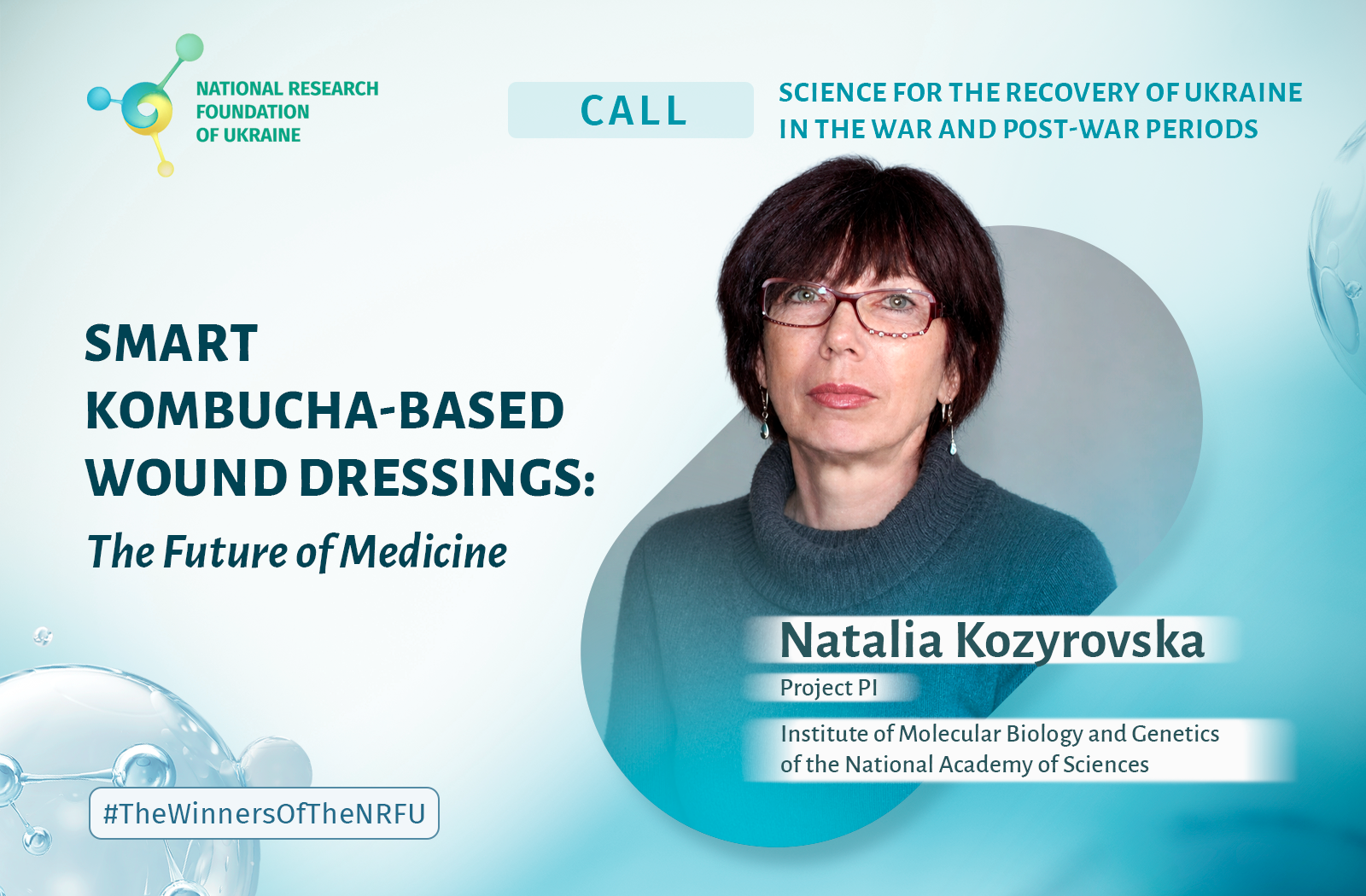
A research group from the Institute of Molecular Biology and Genetics of the National Academy of Sciences of Ukraine, led by Natalia Kozyrovska, Head of the Laboratory of Microbial Ecology, set out to address this pressing medical challenge. Their project, “Hydrogel Smart Dressings for Wound Healing Monitoring”, was selected for funding under call for proposals of the National Research Foundation of Ukraine “Science for the Recovery of Ukraine in the War and Post-War Periods”.
The researchers have developed a smart wound dressing capable of signalling the condition of wound via an ordinary smartphone screen.
From Traditional Remedies to Cutting-Edge Technologies
At the heart of this innovation is kombucha culture, more commonly known as tea fungus. Acetic acid bacteria naturally present in the culture produce bacterial cellulose, a unique biopolymer. This natural hydrogel serves as an almost ideal wound dressing: it reduces pain, inhibits the growth of pathogens and conforms to the shape of the wound.
“In the distant 1950s, natural hydrogel dressings were successfully used in hospitals for this purpose”, explains Natalia Kozyrovska. “Kombucha microorganisms have antimicrobial properties and produce valuable metabolites that promote wound healing. However, with the beginning of the triumphant era of pharmaceuticals, chemical alternatives gradually replaced these natural materials in hospitals. When bacterial cellulose attracted renewed attention around three decades ago, researchers began removing the beneficial microorganisms from it. Due to strict regulations governing use of microbial products in contact with human skin, their application became limited. As a result, natural pellicles began to be sterilised and artificially supplemented with chemical antimicrobials”.
Ukrainian researchers decided to use the unique three-dimensional network structure of bacterial cellulose, whose architecture closely resembles that of human skin. The nanoscale channels within this polymer became an ideal reservoir for smart loading with medicines or biosensors.
Black Elderberry instead of Chemical Indicators
The key feature of the Kyiv biotechnologists’ innovation is the integration of natural biosensors into the hydrogel, enabling it to indicate the condition of a wound. The researchers selected anthocyanins for this purpose – natural pH-sensitive pigments extracted from common plants such as black elderberry and red cabbage.
These compounds perform a dual function: they possess naural wound healing properties while also acting as precise indicators. When an infection enters a wound and inflammation begins, the pH level changes. The biosensor immediately responds to this shift, causing the dressing to change colour before the first signs of inflammation can be detected by the naked eye.
To detect these changes, neither patients nor healthcare professionals need to carry out painful procedures, take tissue scrapings or collect samples for microbiological analysis. An ordinary smartphone is all it takes. A spcialized mobile application analyses the colour of the dressing and immediately indicates whether everything is normal or, conversely, whether there are signs of infection requiring medical intervention. This makes it possible to monitor the healing process while significantly reducing hospitalisation costs and the need for antibiotic therapy.
The safety and non-toxicity of the smart dressings have already been officially confirmed in preclinical studies conducted in accordance with international OECD requirements by the L. I. Medved’s Research Centre of Preventive Toxicology, Food and Chemical Safety of the Ministry of Health of Ukraine.
Science Meets Production: Wartime and Bureaucratic Hurdles
The technology for creating therapeutic and diagnostic wound dressings has already been successfully tested with an industrial partner – SPRAGA DISTRIBUTION LTD, a manufacturer of functional kombucha-based beverages. Together with industry, the researchers have gone through a challenging journey from laboratory development to the launch of a pilot production line. The results of testing the technological process confirmed that the technology is ready for implementation. However, the path from innovation to mass production continues to face legal and administrative barriers.
“Unfortunately, the journey from the laboratory to the production floor takes years”, says Natalia Kozyrovska. “The challenge is not the technology itself but the costly procedures required to obtain approvals and outdated management practices in academic science. Public research institutions in Ukraine are not allowed to sell patents, while businesses can only access these developments through licensing agreements. This doesn’t motivate either developers or manufacturers. Legislative changes are needed, along with incentives for businesses producing knowledge-intensive products, at least for the period of martial law”.
The war has also created a number of practical challenges. Due to limited funding, the research group was unable to hire professional process engineers, while some staff members left the country. Those who remained had to quickly acquire new skills: working in a production environment, preparing technological documentation and adapting to the requirements of an industrial facility.
Today, the technology is fully ready for industrial production of hydrogel dressings. The introduction of such smart dressings to the Ukrainian wound-care market is now a matter of time, financial support and regulatory reform. The successful completion of the preclinical stage offers hope that these innovative dressings will soon become available to patients.
Interviewed by Svitlana GALATA