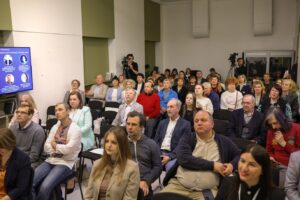
On the eve of Science Day in Ukraine, the National Research Foundation of Ukraine brought together researchers, innovators, representatives of the Government, the Verkhovna Rada of Ukraine and European institutions for the event “Integration of Ukraine into the European Research Area”. The central question of the meeting was what opportunities are already available to Ukrainian researchers through European programmes and how they can make use of them.
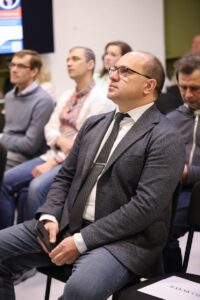 Deputy Minister of Education and Science of Ukraine Denys Kurbatov recalled that Ukraine had successfully completed the screening under Negotiation Chapter 25, “Science and Research”, of the EU accession process.
Systemic work is underway to transform the research sector; a network of National Contact Points has been established; the Horizon Europe Office in Ukraine is actively operating; and more and more projects, programmes, institutions and researchers are joining Europe’s largest research programme. Denys Kurbatov also highlighted the role of the NRFU, which was established relatively recently and, despite all the challenges of wartime, continues to expand its activities, increase the number of programmes and grants, and develop international partnerships. The potential of Ukrainian science, the Deputy Minister stressed, is exceptionally high.
 Yuriy Petrushenko, Director of the Fund of the President of Ukraine for Education, Science and Sports, spoke about the Fund’s support programmes for talented young people and a pilot project aimed at inviting foreign researchers to Ukrainian universities. This year, ten British researchers will come to ten Ukrainian universities. The first lecturers from Cambridge have already visited Ivan Franko National University of Lviv and Vasyl Stefanyk Carpathian National University. Importantly, there has been strong interest among foreign researchers, which means that global interest in Ukrainian science is very high.
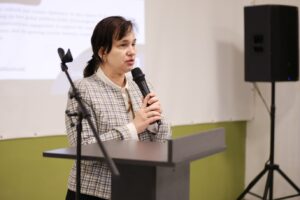
Oleksandra Antoniuk, Chair of the Scientific Committee of the National Council of Ukraine for the Development of Science and Technology, spoke about the Committee’s work. She emphasised that the Scientific Committee is a representative body of researchers that protects their interests. Oleksandra Antoniuk also stressed that today, amid hybrid warfare, technologies are not the only matter of importance. In her view, the social sciences and humanities influence people’s consciousness no less than weapons do and therefore deserve a separate national discussion. The Scientific Committee has already launched a series of seminars on this topic. The next one will be the online discussion “Is Culture a Weapon or Not?”. A researcher from the Diplomatic Academy of Vienna has been invited to join the conversation.
European integration: not an external path, but part of Ukraine’s DNA
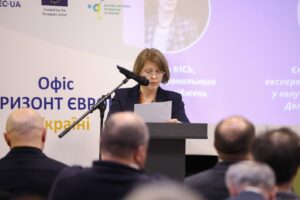
Oksana Kis, Head of the NRFU, recalled that from the very beginning the Foundation was designed in line with European practices, with transparent rules and call procedures, a strong commitment to competitiveness, and a clear results-oriented approach. Therefore, in her words, European integration is not an external course, but part of the Foundation’s DNA. Today, the NRFU is a partner of many European foundations, a participant in international consortia, and a member of Science Europe.
There have been many tangible results. Joint calls with the University of Cambridge, the Swiss National Science Foundation (SNSF) and the Research Council of Norway (RCN) have been fully funded by partners. Ukrainian researchers have gained the opportunity to join Dutch and Norwegian research teams through a joint initiatives of the NRFU with the Dutch Research Council (NWO) and the Research Council of Norway (RCN), and a joint call with the German Research Foundation (DFG) is being prepared.
The Head of the Foundation also spoke separately about the Horizon Europe Office in Ukraine, whose activities are fully funded by the European Commission. Thanks to the work of the Office, Ukrainian researchers are participating more actively in European programmes. A decision has recently been adopted to continue the work of the Office, and, in Oksana Kis’s view, this is one of the most important international contributions to supporting Ukrainian science during the war.
Concluding her speech, she emphasised that the result of the Foundation’s work is not limited to individual examples, projects or initiatives. “It is about changes that are born from this experience, about new points of reference and shared meanings that we are shaping for the future,” Oksana Kis noted. “It is about a new academic culture, standards of quality, integrity, openness, trust and scientific solidarity. It is also about the courage to take responsibility and define our own future.”
A few years ago, different state bodies were moving towards the same goal, but each in its own direction
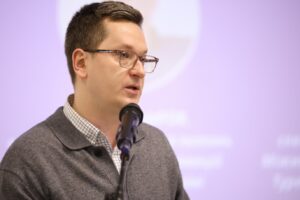
Yehor Pyvovarov, Policy Officer for Research and Innovation at the EU Delegation to Ukraine, spoke about changes in Ukraine’s research sector that the European Commission is indeed noticing. Legislation is being reformed, and key institutions have synchronised their work. According to Yehor Pyvovarov, only a few years ago different state bodies were moving towards the same goal, but each in its own direction. This has now changed.
At the same time, Yehor Pyvovarov also spoke about issues that raise concern. Research funding remains insufficient, governance is fragmented, and the commercialisation of research developments is weak. The European Commission openly notes concerns regarding cooperation between science and business. Reforms must not remain only at the level of laws: their implementation is what matters, and it will become the main indicator for the European side.
He also emphasised that Ukraine today has what cannot be created artificially: strong people, a strong research tradition, enormous potential and the experience of resilience that inspires admiration in the European Union.
“We are not talking about integration – you are already integrated”
Frederik Søndergaard, Policy Officer, DG Research and Innovation, European Commission, joined the event online and spoke about the most important point: the European Commission sees Ukrainian researchers not as subjects of support, but as contributors to Europe’s shared scientific future. He underlined that significant funding has been allocated for research in Ukraine for 2026–2027, and that work on the International Coalition for Science, Research and Innovation is one of the priorities.
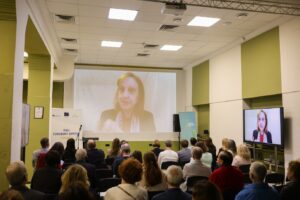
Lidia Borrell-Damián, Secretary General of Science Europe, spoke about the fact that Ukraine’s voice is now heard in the places where global research policies are shaped. “We are not talking about integration – you are already integrated,” she said.
Science Europe has been cooperating with the NRFU since 2022: Ukrainian specialists participate in several SE working groups, including those on Open Science, science communication, research culture and the Horizon Europe Programme. Dr. Borrell-Damian spoke about the series of webinars that Science Europe organises jointly with the NRFU and noted that Ukraine has already been included in the association’s new strategy for 2027–2030.
She also mentioned separately that in a few days she would travel to Bangkok for the Annual Meeting of the Global Research Council (GRC), where the NRFU would also take part. “If you have ideas on how we can help you, I will be very happy,” Lidia Borrell-Damián added.
Horizon Europe Office in Ukraine: a new start
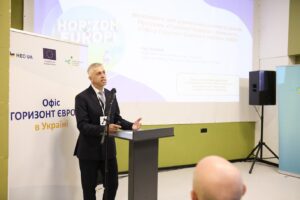
Igor Taranov, Head of the Horizon Europe Office in Ukraine, presented the results of almost three years of work. The main outcome is that Ukrainian researchers, universities, research institutions and businesses have already attracted EUR 64.3 million under the Horizon Europe Programme. This is more than during all seven years of the previous Horizon 2020 Programme. The number of projects in which Ukrainian organisations act as coordinators has increased from one to fourteen. Igor Taranov emphasised that assuming coordination is a serious responsibility, and the fact that Ukrainian institutions are ready to take it on is a sign of maturity.
Over the past year, the Office has held more than 120 online and 73 offline events, reached almost 20,000 participants, and maintains a database of more than 5,500 contacts.
Another important announcement concerned the continuation of the HEOinUA project: the European Commission recently adopted the relevant decision. The success of the Ukrainian Office has also inspired the European Commission to create a similar structure in Moldova. “Our Moldovan colleagues are already asking how we manage to attract an audience,” the speaker noted with a smile. “We answer that it is the result of joint, intensive and systematic work.”
Ukraine’s challenges and tasks on the path to the EU in the field of science
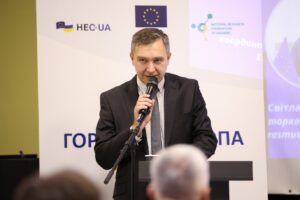
Hryhorii Mozolevych, Director General of the Science Development Directorate at the Ministry of Education and Science of Ukraine, presented a detailed picture of where Ukraine currently stands on its path towards the European Research Area. The new Roadmap for Integration for 2026–2027 has been approved. It outlines 113 tasks: eight have already been completed, and 64 are currently in progress. Ukraine’s research budget increased by 41% in 2026. Of course, this is not the 1.7% of GDP expected under European benchmarks, but a step has been taken.
He also spoke separately about the Horizon Europe Programme. The most optimistic scenario at the time of signing the association agreement envisaged attracting EUR 70 million. Today, Ukraine is approaching EUR 100 million. “The target for 2027 is more than 4,000 applications and more than 400 ongoing projects. By comparison, in NATO’s Science for Peace and Security (SPS) programme, Ukraine has already become a country without which every second project cannot be implemented,” he added.
Programmes and tools for Ukrainian researchers
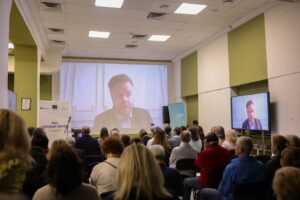
Representatives of various projects and organisations spoke about concrete opportunities for Ukrainian researchers. Frederik Søndergaard presented the objectives and opportunities of the International Coalition for Science, Research and Innovation in Ukraine.
Oksana Schwaika from the DAAD Information Centre in Kyiv presented scholarship programmes for doctoral students and researchers: from a full doctoral programme with a dissertation defence in Germany to short-term research stays. She also spoke separately about the “Ukraine’s Future” programme – six-month research opportunities for master’s students and researchers, which opens for applications twice a year – and the Leonhard Euler Programme for those who wish to remain working in Ukraine: conducting research at home under the supervision of a German academic supervisor, with a one-month research stay in Germany.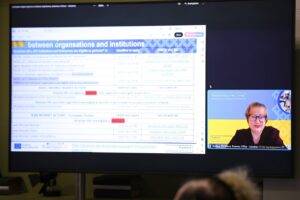
Svitlana Shytikova, National Erasmus+ Office – Ukraine Project Coordinator, recalled that the programme covers not only student exchanges, but also a research component: joint projects, university capacity building, support for doctoral students, and access to European laboratories. Forty calls under the programme are open to Ukraine. The United Kingdom is expected to return to the programme soon, and Switzerland is expected to join it.
Maurizio Toscano from the Spanish Foundation for Science and Technology (FECYT) presented a portal for Horizon Europe participants, which includes more than 30 online courses, annotated examples of successful proposals, and a separate virtual campus for beginners. He also noted that some of the materials had recently been translated into Ukrainian for the first time.
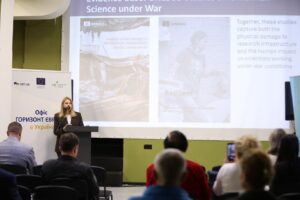
Olena Tsyplitska from UNESCO Antenna Ukraine spoke about the Action Plan for Science, which provides for access to equipment, support for STEM in schools, grant support for researchers, safeguarding psychosocial well-being, and institutional capacity building.
In particular, the UNESRALE programme provides free six-month access to advanced laboratory equipment abroad for Ukrainian researchers with specific projects. Five calls have already been launched, with partners including laboratories in EU countries and representatives of the ERIC consortium. Two calls are currently open: remote training on crystallography software and the Cambridge Structural Database (CSD), in collaboration with the Cambridge Crystallographic Data Centre (CCDC), and access to the BBMRI-ERIC biobanking infrastructure in Austria..
The event concluded with brief remarks by Igor Taranov. He encouraged researchers to make use of the opportunities discussed during the meeting and stressed that for Ukrainian researchers it is “Ukraine and science above all”, and that research developments and innovations help defend the country and resist aggression.
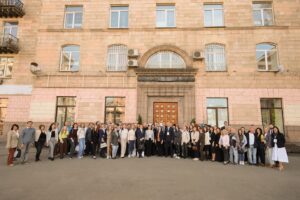
The National Research Foundation of Ukraine sincerely thanks Ukrainian researchers, representatives of universities and research institutions who continue to work, conduct research and advance science even in wartime. Special gratitude goes to international partners and organisations that support the Ukrainian research community: the European Commission, Science Europe, UNESCO, DAAD, Erasmus+, FECYT, as well as all foundations, programmes and institutions that create opportunities for development, cooperation, academic exchanges and the implementation of new research.
Behind each of these partnerships are people who believe in Ukraine and its scientific potential, support Ukrainian researchers, and help preserve and develop science even in the most difficult times.
A video recording of the event is available at the following link: